
Tria's card help article says card support is active in 150+ countries but not everywhere yet, and its KYC article says the full list of over 200 supported regions is the Country dropdown inside the app. Named examples include Australia, Canada, Germany, Hong Kong, the UAE, the United Kingdom and the United States. You cannot use Tria if you live in, or transact with, a sanctioned or prohibited jurisdiction listed in Tria's Prohibited Use Policy. KYC happens in the mobile app after your first card purchase: you must be 18 or older, physically present in the country you select, hold matching documents, and not use a VPN.
How to check whether your country is supported
According to Tria's card application guide (updated May 4, 2026), you pick a card and then select your country of residence. If the country is supported you go straight to payment; if it is not, the app shows a message that Tria is working to bring the card to your region. Do this check before you move any funds.
Application path: payment is not card issuance
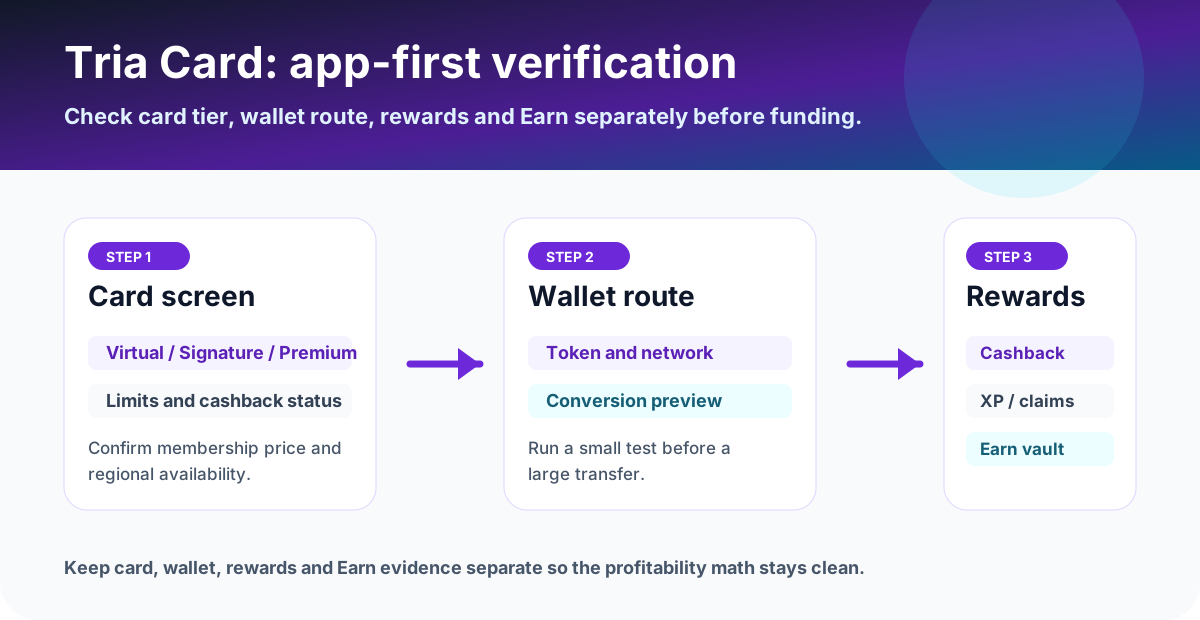
Use the official Apply Now path and select your real country of residence. A country appearing in a dropdown is the only availability signal Tria gives at this stage; it does not promise approval, physical-card shipping or every feature.
- Choose a card and your actual residence. If the app says the country is unsupported, stop there rather than choosing another country.
- Pay only after checking the displayed price and terms. Tria says crypto payment takes you to KYC. With a credit or debit card, retain the receipt and look for the separate email containing a unique 10-digit promo code; return to the country-selection application screen, enter that code and continue.
- Complete KYC in the mobile app. Applicants must be at least 18 and physically present in the selected country. Tria asks for personal details, valid identification and a live selfie.
- Wait for approval and the app status. A payment alone does not issue or ship a card. The paid 10-digit promo code redeems that already-paid purchase; it is not a referral, registration or access code. Pro and Max physical-card delivery starts only when Tria sends the in-app address notification for an enabled shipping country.
If the card-payment email is missing, check spam or junk before contacting in-app support. Do not make a second purchase merely to obtain another code.
Countries Tria does not serve: the Prohibited Use Policy
Tria's Prohibited Use Policy (last updated January 9, 2026) is the closest thing to an official "not supported" list. It blocks two groups of places, plus any jurisdiction where using Tria would be illegal.
| Group | Countries and regions named |
|---|---|
| Sanctions (EU, UK, UN and US programmes) | Cuba, Iran, North Korea, Syria, and the Crimea, Donetsk and Luhansk regions of Ukraine, among others under sanctions |
| High money-laundering, fraud or compliance risk | Afghanistan, Belarus, Central African Republic, Democratic Republic of the Congo, Eritrea, Ethiopia, Guinea, Guinea-Bissau, Iraq, Lebanon, Libya, Mali, Myanmar, Nicaragua, Russia, Somalia, South Sudan, Sudan, Venezuela, Yemen and Zimbabwe (the policy says the list is not exhaustive) |
| Anywhere use would be illegal | Any jurisdiction where your access or use of Tria would otherwise be unlawful |
Not being on this list does not mean a country is supported. It only means Tria has not named it as prohibited. For readers in Nigeria, the International Card Terms add that the card is marketed there by BANEX Microfinance Bank.
Tria KYC requirements
Tria's KYC help article (updated March 20, 2026) and document-requirements article (updated April 9, 2026) set out the rules. KYC is done once; later card purchases do not repeat it.
| Requirement | What Tria says |
|---|---|
| When | After your first card purchase, from the Complete KYC option |
| Device | Mobile app only; KYC cannot be done on a desktop |
| Age and location | 18 or older, and physically present in the country you select |
| Documents | Valid, undamaged ID that matches the selected country; accepted document types differ by country |
| Photo | Live photo that matches your ID, taken in good light, with camera and location permission granted |
| VPN | Using a VPN during the process results in a decline |
| Accounts | One Tria account per person; duplicates are declined |
Tria lists the common reasons for a failed KYC: a duplicate account, incomplete or incorrect details, a suspected politically exposed or sanctioned person, a missing document, an unverifiable photo, an unsupported document, and a region that does not match your documents or live location.
US terms and international terms are not interchangeable
Tria's docs publish two sets of card terms, both last updated January 9, 2026. The U.S. Card Terms are a cardholder agreement with Third National as issuer. The International Card Terms are with Nimbus, LLC as issuer, and require you to attest that you are not a US citizen and that you are signing up for a card intended for people outside the United States. They also say the card may not be available in all jurisdictions and that your local law must permit crypto-collateralised spending.
A supported country does not guarantee every feature
Tria's card help article says features and availability may vary by region. Check the feature you plan to use, not only the card headline.
Check the card screen for Add to Wallet, then read the Apple Pay and Google Pay troubleshooting guide if it fails.
See the Tria fee guide for ATM fees and the 750 USD per-withdrawal limit.
Tria Travel's terms say so directly, so check the app before planning around travel cashback.
Check the country dropdown before paying
Open Tria, start a card application, and stop at the country screen. If your country is listed, compare the price and fees before paying.
Select your real country of residence only.
Note the tier price and whether US or international terms apply.
Good light, valid ID, no VPN, camera and location allowed.
Records to save before applying
- The country screen showing your country as supported, with the date.
- The card tier, price and the card terms (US or international) shown to your account.
- KYC status, accepted document type and any rejection reason.
- Physical-card shipping notification and the address you submitted.
- Support replies about country, KYC, delivery, Apple Pay, Google Pay or ATM availability.
FAQ
Which countries is the Tria Card available in?
Tria's card help article says card support is active in 150+ countries but not everywhere yet, and its KYC article says the full list of over 200 supported regions is the Country dropdown shown in the app when you buy a card. Examples Tria names include Australia, Canada, Germany, Hong Kong, the UAE, the United Kingdom and the United States. There is no public country list on Tria's website, so check the dropdown before paying.
Which countries are banned from using Tria?
Tria's Prohibited Use Policy (last updated January 9, 2026) excludes sanctioned places such as Cuba, Iran, North Korea, Syria and the Crimea, Donetsk and Luhansk regions of Ukraine, plus high-risk jurisdictions including Afghanistan, Belarus, Central African Republic, Democratic Republic of the Congo, Eritrea, Ethiopia, Guinea, Guinea-Bissau, Iraq, Lebanon, Libya, Mali, Myanmar, Nicaragua, Russia, Somalia, South Sudan, Sudan, Venezuela, Yemen and Zimbabwe. The policy says the list is not exhaustive and also excludes any place where using Tria would be illegal.
What do I need for Tria KYC?
According to Tria's help center, KYC starts in the mobile app after your first card purchase. You must be 18 or older, physically present in the country you select, and upload a valid ID accepted for that country plus a live photo that matches it. Allow the app to use your camera and location, do not use a VPN, and keep only one Tria account.
Why was my Tria KYC rejected?
Tria lists the usual reasons as a duplicate account, incomplete or incorrect details, a suspected politically exposed or sanctioned person, a missing or unsupported document, a photo that does not match the ID, and a selected region that does not match your documents or live location. Selecting a supported country you do not live in causes a KYC failure.
Can US citizens get the Tria Card?
US residents are covered by separate U.S. Card Terms with Third National as issuer. The International Card Terms, issued by Nimbus, LLC, require you to attest that you are not a US citizen and that the card is intended for people outside the United States. Follow the terms the app shows to your account.
Does a supported country mean every Tria feature works?
No. Tria says features and availability may vary by region. Apple Pay and Google Pay are offered where supported, physical-card shipping opens country by country, ATM withdrawals need Pro or Max (renamed from Signature and Premium on September 26, 2026), and Tria Travel availability can vary by location.
Official sources checked on October 1, 2026
Country and KYC rules can change with issuer, sanctions and local regulation. The app's country dropdown and KYC result are the final answer.